The Race for Last Place
One of the biggest issues in the
Western World today is economics, and it looks like no easy solution is in
sight. America, the world’s leading power, owes trillions of dollars in debt,
and is dragging down its trading partners along with it. The Eurozone, as well,
is facing bankruptcy, due to several countries not being able to generate
enough economic growth to sustain themselves (About.com). In the midst of this
crisis, several countries outside of the Western World are gaining economic
power. Most notable of these is China, which several people believe could be
the next major power. But is this the
case? Is it really so clear who’s the next major power? Is the Western World
really in that much trouble?
Let’s look at the facts. USA, a
major power in the world, is on a decline. Large amounts of debt, political
deadlock, human rights, and loads of other issues currently plague the States,
but today we will only be focusing on the economic side of things. As of Jan.
23, 2012, the United States owes roughly 16.4 trillion dollars in debt, and has
been trying everything in their power to get rid of it (Washington Post).
Inflation, the recent Fiscal Cliff, and several other attempts have been made
to pay off the debt, but with no easy solution in sight, an economic collapse
seems well within the realm of possibility. If America does go bankrupt, it
will, with no doubt, drag other countries along with it, such as what happened
during the 2008-2009 recession (Wikipedia). This especially affects Canada, for
while we’re a leading exporter of raw materials, most of our trade is done with
USA; in 2009, 70-75% of our exports and 51-62% of our imports were done with
the States (Economy Watch, Canada Foreign Affairs). If the States go dark
though, all that will change. In fact, recent talks on the subject of trade
have suggested redirecting oil, which Canada is a stable supplier of, from the
United States to other countries, such as China (CBC).
"To let it grow unchecked like this is certainly unwise."
As well, countries in Europe face massive amounts of debt. Several,
most notably Greece, have faced slow economic growth, which coupled with rising
debts have caused them to go, or face, bankruptcy (About.com). But with the
European Union, and plenty of trade policies, this has ballooned into an issue
that threatens the entire Eurozone. But
talks are slow, and talks about kicking out these countries from the Union have
ended with no action taking place. And with no easy solution in sight, it seems
that the Eurozone could go dark as well.
 |
| How much more can you take? |
So in the midst of all this, the
biggest question is: Will the Western World face economic collapse in the near
future, and what affect will this have at the world on large? Well, consider
the following. America is $16.4 trillion dollars in debt, and that amount continues
to grow daily; its annual revenue is well below that number (Washington Post). Meanwhile,
the Eurozone’s total debt is on the rise, with it totaling 82.5% of its total
GDP (Gross Domestic Product) in 2011, with some areas well over 100% (BBC). But
who owns most of this debt? Well, in the case of the United States, one might
think China. After all, that’s all what one hears on the news most of the time.
It’s this thinking that’s lead some to believe China is the next superpower.
With cheap labor, a rising economy with a growth rate of 7.4% as of Oct. 2012 and
a strong military, it seems likely they could take control (CNN). All they need
to do is tell America it’s time to pay up, and the United States is bankrupt,
right?
 |
| The cracks have already formed... |
In reality, China contributes to less
than 8% of America’s total national debt (Fox News). Make no mistake, this is
still a hefty amount, roughly 1 trillion dollars, but it is not America’s
primary concern. Realistically, China couldn’t cash in that money either, as,
like Canada, America is their largest trading partner; destroying the American
economy would make a huge dent in their own (USCBC). China could still be a
player for the next major power, but they won’t be the ones to take out the
American economy.
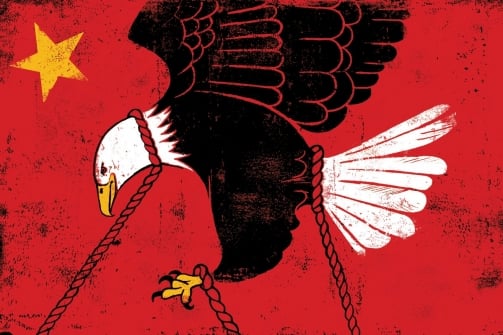 |
| Hate to break it to you, but this is not the case. |
It’s true that China is America’s
largest foreign debt owner, but the total owed to all foreign investors is 11.2
trillion (as of Sept. 2012) (Daily Beast). But the rest of it, 4.7 trillion,
belongs to its own government programs; social security, pensions and Medicare all
contribute massive amounts towards the debt, which now falls to the hands of
American taxpayers. The very same issues plague the Eurozone, especially
Greece; due to over-spending from its government, it borrowed money from other
countries to be able to support its people in a time of economic downturn (BBC).
The Greek people, however, can’t repay the government, and in turn the
government can’t pay back their debt to other countries. It’s a cycle that is
affecting the Eurozone as a whole, and is quickly taking a turn towards the
worse.
 |
| Always the taxpayers, isn't it? |
If a country collapses, that’s money other countries can’t
get back and in turn makes it harder for them to pay their growing debts. In
both areas though, the biggest cause for concern is the people. Due to the
massive amounts governments owe, taxes are taking a turn for the worse. This makes
it harder for companies to keep running; people may decide to cut their own
spending to pay off taxes and debt, which in turn causes it to become harder
for companies to get rid of their inventory. This then forces companies to shut
down production, or shut down entirely, such as what almost happened to automakers
like Chrysler (NYTimes). In a tourist economy like Greece, this hurts a ton,
but as seen in America, which has unemployment rate of 7.8% as of Dec. 2012,
this hurts everyone everywhere (Trading Economics). In other situations,
companies instead look for cheaper workers, instead of the more expensive ones.
This is known as the “race to the bottom”, where companies, to compete, seek
the cheapest labor they can find (Lexicon). This is the reason why places like
China and Brazil, where workers have little rights and work for little pay, are
producing so many goods, and why so little production is done in the Western
World anymore. This is why when you call a call center; you’re talking to
people in places like India. The Western World is being crushed under massive
debts, so companies have moved their workforce to elsewhere in the world, and
with this, the rich get richer, the poor get poorer, unemployment rates rise and
the economy worsens.
 |
| "Thank you for calling Microsoft Support Center, my name is Raj, how can I help you today?" |

Every solution is a dead end, and
with America on the verge of collapse, dragging down Canada and China, two
somewhat stable economies, and other trading partners with it, and the Eurozone
in complete crisis, dragging down their trading partners as well, it seems we’re
on the verge of another worldwide recession, or even a depression. Perhaps the
dominos are falling into place as I type this. In the end, the Western World’s
effect on the global economic climate will be that of an anchor, it’ll just
drag it down. Perhaps the rise of the next major power won’t be a matter of
economics, but military. After all, that’s what happened after the Great
Depression; it’s what got us out of the Great Depression.
It’s a race
for last place, and we’re all heading there, one way or another.
------------------------------------------------------------------------------------------------------------
Works
Cited
"Bankruptcy in the United States." Wikipedia. N.p.: n.p., n.d. Wikipedia.
Web. 24 Jan. 2013. <http://en.wikipedia.org/wiki/Bankruptcy_in_the_United_States>.
Boesler, Matthew. "The Hottest Economies In The World." Business Insider. Business Insider, 20
June 2012. Web. 24 Jan. 2013.
<http://www.businessinsider.com/29-of-the-worlds-fastest-growing-countries-2012-6?op=1>.
"Canada Exports, Imports & Trade." Economy Watch. Stanley St. Labs, 10 Mar.
2010. Web. 24 Jan. 2013.
<http://www.economywatch.com/world_economy/canada/export-import.html>.
Capaccio, Tony, and Daniel Kruger. "China’s U.S. Debt
Holdings Aren’t Threat, Pentagon Says." Bloomberg. Bloomberg L.P., 10 Sept. 2012. Web. 24 Jan. 2013.
<http://www.bloomberg.com/news/2012-09-11/china-s-u-s-debt-holdings-aren-t-threat-pentagon-says.html>.
"Economy of the European Union." Wikipedia. N.p.: n.p., n.d. Wikipedia.
Web. 24 Jan. 2013.
<http://en.wikipedia.org/wiki/Economy_of_the_European_Union>.
"Eurozone crisis explained." BBC News. BBC, 27 Nov. 2012. Web. 24 Jan. 2013.
<http://www.bbc.co.uk/news/business-13798000>.
"Great Recession." Wikipedia.
N.p.: n.p., n.d. Wikipedia. Web. 24
Jan. 2013. <http://en.wikipedia.org/wiki/Great_Recession>.
"Greek government-debt crisis." Wikipedia. N.p.: n.p., n.d. Wikipedia.
Web. 24 Jan. 2013.
<http://en.wikipedia.org/wiki/Greek_government-debt_crisis>.
Hawkins, John. "5 Things That Will Happen To You When America
Goes Bankrupt." Townhall.
Townhall, 12 Apr. 2011. Web. 24 Jan. 2013.
<http://townhall.com/columnists/johnhawkins/2011/04/12/5_things_that_will_happen_to_you_when_america_goes_bankrupt/page/full/>.
"Hyperinflation in Zimbabwe." Wikipedia. N.p.: n.p., n.d. Wikipedia.
Web. 24 Jan. 2013.
<http://en.wikipedia.org/wiki/Hyperinflation_in_Zimbabwe>.
"In graphics: Eurozone crisis." BBC News. BBC, 27 Sept. 2012. Web. 24 Jan. 2013.
<http://www.bbc.co.uk/news/business-13361930>.
Kenny, Thomas. "What is the European Debt Crisis?" About.com. About.com, n.d. Web. 24 Jan.
2013.
<http://bonds.about.com/od/advancedbonds/a/What-Is-The-European-Debt-Crisis.htm>.
Kessler, Glenn. "Why is the national debt $16 trillion?"
The Washington Post. Washington Post,
4 Jan. 2013. Web. 24 Jan. 2013.
<http://www.washingtonpost.com/blogs/fact-checker/post/why-is-the-national-debt-16-trillion/2013/01/03/e2a85386-55fc-11e2-8b9e-dd8773594efc_blog.html>.
Mucha, Tom. "Who owns America? Hint: It's not China." CNN. Cable News Network, 21 July 2011.
Web. 24 Jan. 2013.
<http://globalpublicsquare.blogs.cnn.com/2011/07/21/who-owns-america-hint-its-not-china/>.
Patton, Mike. "Is America Bankrupt?" Forbes. Forbes, 23 July 2012. Web. 24
Jan. 2013. <http://www.forbes.com/sites/mikepatton/2012/07/23/is-america-bankrupt/>.
"Race to the Bottom." Financial Times Lexicon. Financial Times, n.d. Web. 24 Jan. 2013.
<http://lexicon.ft.com/Term?term=race-to-the-bottom>.
"Race to the bottom." Wikipedia. N.p.: n.p., n.d. Wikipedia.
Web. 24 Jan. 2013. <http://en.wikipedia.org/wiki/Race_to_the_bottom>.
Riley, Charles. "China's GDP growth slides to 7.4%." CNNMoney. Cable News Network, 17 Oct.
2012. Web. 24 Jan. 2013.
<http://money.cnn.com/2012/10/17/news/economy/china-gdp/index.html>.
Rogers, Simon, and John Burn-Murdoch. "Eurozone debt crisis:
the key charts you need to understand what's happening." The Guardian. Guardian News and Media,
15 Nov. 2012. Web. 24 Jan. 2013.
<http://www.guardian.co.uk/news/datablog/2011/nov/07/euro-debt-crisis-data>.
Rutenberg, Jim, and Bill Vlasic. "Chrysler Files to Seek
Bankruptcy Protection." The New York
Times. New York Times, 30 Apr. 2009. Web. 24 Jan. 2013.
<http://www.nytimes.com/2009/05/01/business/01auto.html?pagewanted=all>.
Sivy, Michael. "The Six Daunting Financial Problems Facing
America." Time. Time, 21 Aug.
2012. Web. 24 Jan. 2013.
<http://business.time.com/2012/08/21/the-six-daunting-financial-problems-facing-america/>.
"United States fiscal cliff." Wikipedia. N.p.: n.p., n.d. Wikipedia.
Web. 24 Jan. 2013.
<http://en.wikipedia.org/wiki/United_States_fiscal_cliff>.
"United States of America - A Global Commerce Strategy
Priority Market." Foreign Affairs
and International Trade Canada. Foreign Affairs and International Trade
Canada, n.d. Web. 24 Jan. 2013.
<http://www.international.gc.ca/commerce/strategy-strategie/r1.aspx?view=d>.
"United States public debt." Wikipedia. N.p.: n.p., n.d. Wikipedia.
Web. 24 Jan. 2013.
<http://en.wikipedia.org/wiki/United_States_public_debt>.
"United States Unemployment Rate." Trading Economics. Trading Economics, n.d. Web. 24 Jan. 2013.
<http://www.tradingeconomics.com/united-states/unemployment-rate>.
"US-China Trade Statistics and China's World Trade
Statistics." The US-China Business
Council. US-China Business Council, n.d. Web. 24 Jan. 2013.
<https://www.uschina.org/statistics/tradetable.html>.
"The U.S. Government Doesn’t Really Owe $16 Trillion in
Debt." The Daily Beast. Daily
Beast, 5 Sept. 2012. Web. 24 Jan. 2013. <http://www.thedailybeast.com/articles/2012/09/05/the-u-s-government-doesn-t-really-owe-16-trillion-in-debt.html>.
"What does Canada trade with China?" CBC News. CBC, 12 July 2012. Web. 24
Jan. 2013.
<http://www.cbc.ca/news/canada/story/2012/06/19/f-canada-china-trade.html>.
Wilson, Greg. "US debt tops $16 trillion: So who do we owe
most of that money to?" Fox News.
Fox News Network, 4 Sept. 2012. Web. 24 Jan. 2013.
<http://www.foxnews.com/politics/2012/09/04/who-do-owe-most-that-16-trillion-to-hint-it-isnt-china/>.

You said that Greece's bankruptcy affects the whole Euro-zone and yet they are still hesitant to kick them out,which may be true, but they have taken some steps to keep Greece from dragging the rest of them down. Many countries in Europe are now using the Euro as a common currency and Greece was one such country that had adopted the Euro. That is until shortly after they went bankrupt. With Greece bankrupt their money had very little value and because it was the same money that other countries used it brought down the value of their money as well. To keep their economies from plummeting the Euro-zone forced Greece to stop using the Euro as their form of currency and go back to their old form of currency the drachma. This helped seperate other European countries from Greece's problems.
ReplyDeleteMelody, are you sure that Greece doesn't use the Euro anymore? I couldn't find evidence of that point.
DeleteTyler, you used great sources to support your argument. You were also very thorough in your explanation of the economic crisis. I'm not sure what you meant by "taxes are taking a turn for the worst". What is the tax rate in America? Why isn't raising taxes a viable solution? I couldn't help but feel deflated about the future after reading your post. Is there any possibility of a positive outcome?
ReplyDelete